
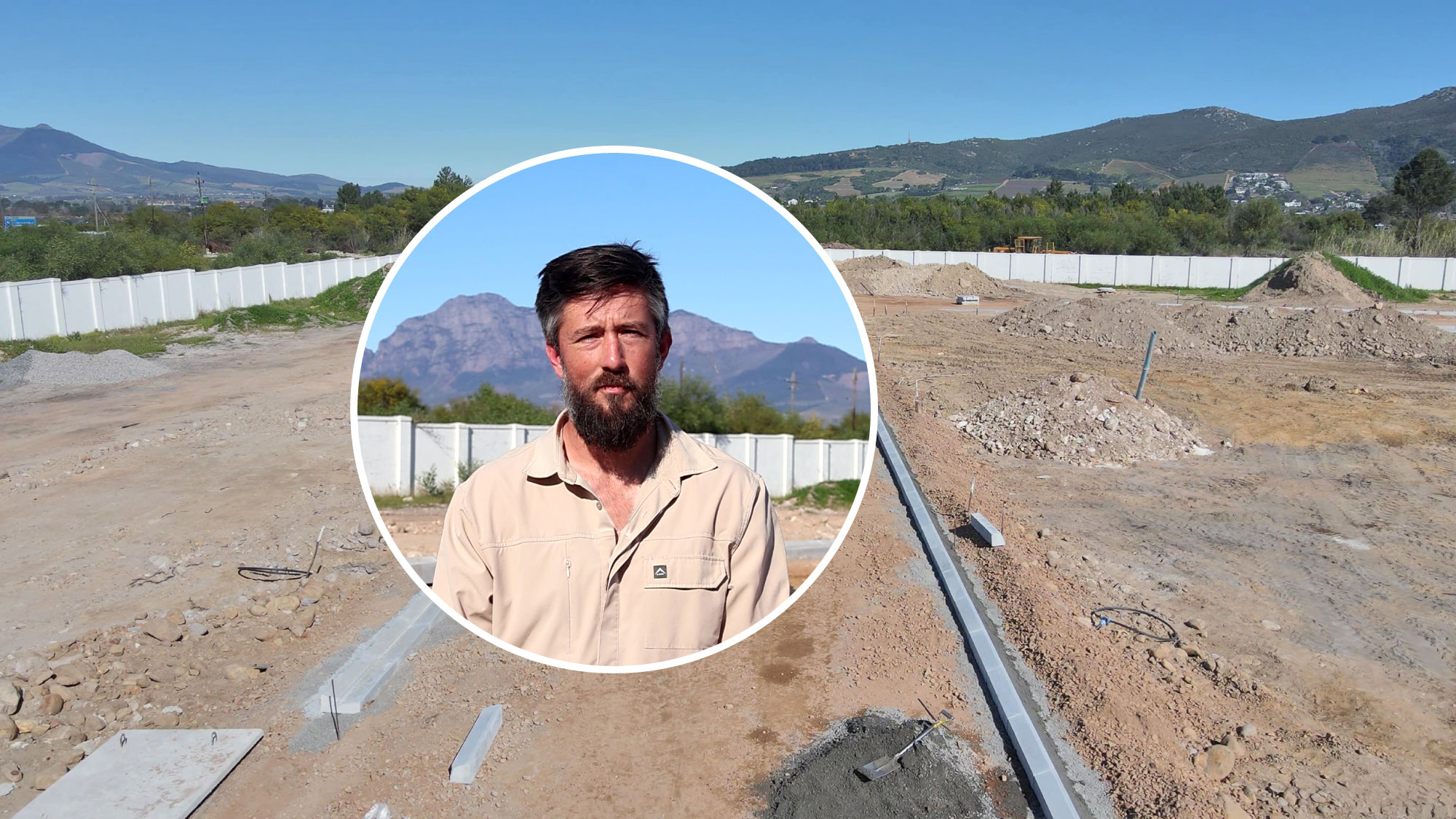
From Construction Site to Community: Behind the Scenes at Huguenot Estate
A behind-the-scenes conversation with Wilhelm Burger of Amandla Construction
There is a moment in every residential development when you stop seeing a construction site and start seeing a neighbourhood.
At Huguenot Estate in Paarl, that moment is happening now.
As roads begin to take shape, kerbs are going in and the boundaries of individual erven become visible, the construction progress at Huguenot Estate is transforming plans on paper into the beginnings of a new residential community in the Paarl Winelands.
We caught up with Wilhelm Burger from Amandla Construction to find out what is happening behind the scenes, what goes into building the infrastructure of a new residential estate, and what makes the construction of Huguenot Estate different.
“That’s when it starts feeling like a place instead of a project.”
For Wilhelm, one of the most exciting milestones so far has been seeing the kerbs going in.
“Up to that point, you have earthworks and open trenches, and it is still just a construction site. The moment we start laying the kerbs, you can see the street lines and the erf boundaries. That is when it starts feeling like a place instead of a project.”
And that transformation doesn’t happen by accident.
Every day on site starts with preparation. Surveyors set out ahead of the crews, materials are booked in advance, and each morning begins with a toolbox talk and a clear target for the day.
The site agent and foremen keep the work moving, while anything going into the ground is checked before it is covered.
The Construction Work You Don’t See
Wilhelm’s role sits on the commercial and contracts side, meaning much of his time is spent working with drawings, measurements and paperwork.
But the best part of the job?
“The best part is the site days, when the thing you have been costing and administering is standing there in the ground.”
And some of the most important work will never be visible once the estate is complete.
Attention to detail. First time right.
When asked what one skill every construction worker needs, Wilhelm’s answer was simple:
“Attention to detail, and the discipline to get it right the first time.”
Why?
Because once a pipe is backfilled, nobody sees it again.
It is the careful work that gets buried today that has to be trusted for decades to come.
Did you know? The rock excavated on site is being put back to work.
One of the most interesting facts about the construction process at Huguenot Estate is what happens to the material that comes out of the ground.
Instead of simply removing excavated rock and bringing in new material from a quarry, Amandla Construction uses a jaw crusher on site to break down the excavated rock into graded material.
That material can then be used in the road pavement layers.
The result?
Hundreds of truckloads of material don’t need to leave the estate or be brought back in.
It means less fuel, less pressure on the surrounding road network and less reliance on virgin quarry material.
It is a practical example of how what’s already on site can become part of what is being built.
If Wilhelm could name one of the roads…
We couldn’t resist asking Wilhelm what he would call one of the estate’s roads.
His choice?
Rochelle or La Rochelle.
The reason is particularly fitting.
La Rochelle was one of the great Huguenot strongholds in France, while the name already forms part of Paarl’s own history.
For Wilhelm, it would create a connection between Huguenot Estate and the origins of the people after whom the estate is named.
Deliberate. Grounded. Home.
Those are Wilhelm’s three words for Huguenot Estate.
And perhaps they capture the project better than expected.
Unlike much of Amandla Construction’s work, which takes place in municipal environments, live streets and around existing services and traffic, Huguenot Estate is being created from open ground — an entire neighbourhood being built at once, to a single standard.
“That is truly enjoyable. The location helps too.”
Quality Construction Starts Below the Surface
For future homeowners, perhaps the most reassuring insight is that much of the quality of the estate is established long before the keys are handed over.
Wilhelm explains:
“Nothing gets covered up on trust.”
Water mains are pressure-tested. Sewer lines are inspected before being backfilled and approved.
In other words, the infrastructure supporting your future home isn’t something that only gets checked once everything looks finished.
It is tested along the way — including the parts that eventually disappear beneath the roads and gardens.
A neighbourhood is built long before the first family moves in.
Every road, pipe, kerb and foundation is another step towards creating a place where people will eventually live, connect and make memories.
Today, you can see the construction.
Tomorrow, you’ll see the streets.
And soon, you’ll see the first homes taking shape.
Discover Huguenot Estate in Paarl
Huguenot Estate is a new residential development in Paarl, situated in the Paarl Winelands. The estate is being developed as a community of full-title homes, with carefully planned roads, infrastructure and shared outdoor spaces designed to create a place where residents can live, connect and feel at home.
As construction progresses, follow the Huguenot Estate development journey and discover what it means to be part of a new community taking shape in Paarl.